How long should I actually budget per person for bridal hair and makeup on a wedding morning?
A working method for building per person timing from your own trial data, with buffer placement, the bride's slot, and the two points where a wedding morning timeline usually breaks.
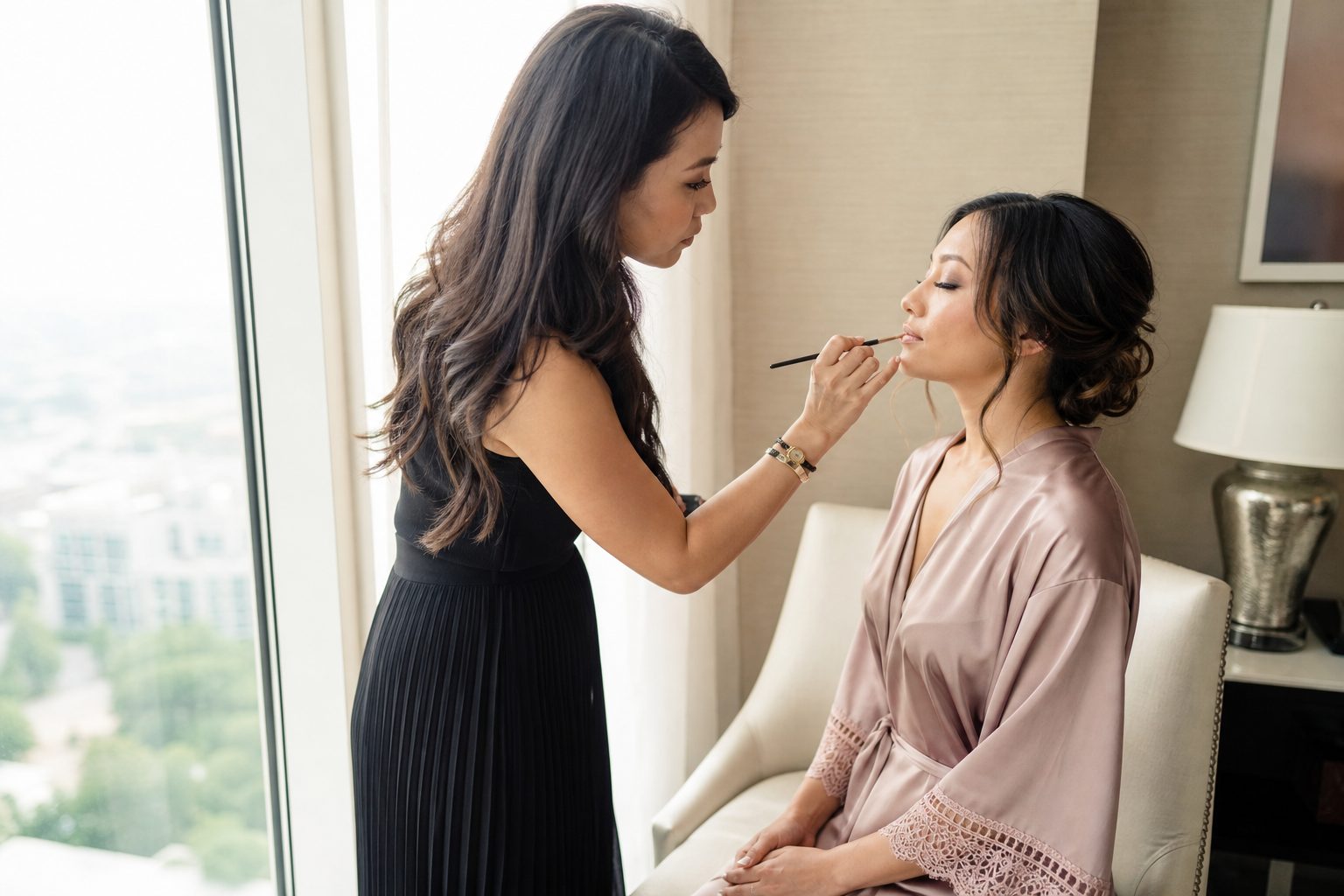
For most bridal work the honest answers are these: 45 to 60 minutes for bridal makeup, 60 to 75 for bridal hair, 30 to 40 for a bridesmaid makeup application, and 35 to 45 for bridesmaid hair. Mothers usually sit somewhere between the bride and the bridesmaids, closer to 40 minutes each service, because the conversation is longer and the skin prep is slower.
Those are starting numbers, not your numbers. The only timing that holds up is timing you have measured on your own hands, with your own products. And the number you budget is never the number you perform in. It is performing time plus the seat change, the photographer leaning in, and the bridesmaid who is still in the shower.
What follows is the method for turning your trial into a defensible per person estimate, then stacking those estimates into a running order that survives contact with a real getting ready suite.
Why per service timing beats a flat forty five minute rule
The flat rule feels efficient. Eight people, 45 minutes each, two artists, four hours. Clean. It is also how mornings run 40 minutes late, because a flat rule hides the fact that a smooth 20s bridesmaid with a blowout is a very different job from a mother of the groom in a wig topper who wants coverage over rosacea.
The variance is not random. It clusters around specific factors you can see at the trial or on the questionnaire:
- Hair length and density. Waist length thick hair takes real time to section, curl and set. A shoulder length bob does not.
- Whether the style is down, half up, or a pinned updo. A pinned updo is the longest job in the room after the bride.
- Extensions. Clip ins add 10 to 15 minutes if you are placing and blending them yourself.
- Skin that needs correction. Texture, redness, active breakouts, mature skin that needs slower priming all add minutes at the base stage.
- Strip lashes versus individuals. Individuals can add 10 minutes per person and they add it unpredictably.
A flat rule averages all of that away, then hands you the average as though it were a guarantee. Per service timing keeps the variance visible so you can place it deliberately.
Keep reading: Should I charge a flat bridal party rate or price every service individually this season?
Timing hair and makeup separately, then stacking them
Time each service as its own block, because that is how the morning actually runs. A person occupies a hair chair and a makeup chair, and those are two separate resources.
Build your table like this, using your own measured medians:
| Person | Hair | Makeup | Total chair time |
|---|---|---|---|
| Bride | 70 min | 60 min | 130 min |
| Bridesmaid, updo | 45 min | 35 min | 80 min |
| Bridesmaid, hair down | 35 min | 35 min | 70 min |
| Mother | 40 min | 40 min | 80 min |
| Flower girl | 15 min | 10 min | 25 min |
Now stack. With two artists, one on hair and one on makeup, the party moves through in a rough pipeline. A six person party of bride, three bridesmaids in updos, one mother and one flower girl comes to about 250 minutes of hair and 220 of makeup. The binding constraint is hair at just over four hours, and that assumes zero gaps between chairs, which never happens.
This is why the pipeline model matters more than the sum. Your finish time is set by the busiest artist plus the dead time between clients, not by total labor divided by heads.
Accounting for the seat change
Add four to five minutes between every client for the seat change: the previous person getting up, sanitizing, resetting brushes, calling the next name and waiting for her to appear. On a seven person morning that is 30 minutes of real time that appears nowhere in your service estimates. Budget it explicitly or it will eat your buffer before the buffer is needed.
Where the bride belongs in the running order
Not first, and not last. The classic mistake is putting the bride first because she is the priority. Her makeup then sits for four hours in a warm room, and she is watching everyone else get ready with nothing to do.
Put the bride second to last, with one bridesmaid finishing after her. That way:
- Her makeup is fresh for photos and for the first look.
- You are warmed up and the room rhythm is established.
- If the morning has run behind, you have already absorbed the delay in the bridesmaids rather than in the person who cannot be rushed.
- The final bridesmaid gives you a working buffer. If you are on time she gets an unhurried service. If you are late, she is the one person whose service can compress without anyone noticing.
The exception is a first look scheduled early or a bride who is also the one driving everyone to the venue. Ask about both at the trial.
Building buffer that survives a late bridesmaid
Buffer at the end of the day is not buffer. It is hope. By the time you reach the end you have already spent it.
Distribute buffer instead. A workable rule: add 10 percent to your total service time, then place two thirds of it in the middle third of the schedule and one third at the end, protected as a hard stop before photographer arrival.
Worked example. Seven services totaling 300 minutes of hair. Ten percent is 30 minutes. Place 20 minutes as two 10 minute gaps after the third and fifth clients, and hold 10 minutes at the end. Those mid morning gaps are where a late bridesmaid gets absorbed, where you eat something, and where the bride's mother asks you the question she has been holding since eight.
Keep reading: What goes wrong when I book a bridal trial three months before the wedding day?
Photographer detail shots and the getting ready window
Photographers typically arrive 90 minutes to two hours before the bride gets into the dress, and the first thing they want is detail shots: rings, invitation suite, shoes, the dress on a hanger in good light. That happens without you.
What affects you is the second phase. Photographers want candid coverage of the bride in the chair, and they will often ask for the final touch up to be re staged. That is a real five to ten minutes, and it lands on the bride, which is exactly where you have least slack.
Two practical moves. First, ask the planner or the couple for the photographer's arrival time before you build the sheet, not after. Second, schedule the bride's finish 20 minutes before the dress time rather than five, and tell the photographer that window is theirs. You look generous and you have protected your own margin.
How many artists a party size actually requires
Work backwards from the getting ready window, which is usually four to five hours in a hotel suite and shorter than that at a venue with a hard access time.
Decision rule for a four hour window, both services for everyone:
- Up to 4 people: one hair artist and one makeup artist.
- 5 to 7 people: two hair and one makeup, or two and two if the party is heavy on updos.
- 8 to 10 people: two hair and two makeup, minimum.
- 11 or more: three and three, or extend the window and negotiate an earlier access time.
To check any staffing plan, divide the largest single service total by the number of artists in that discipline and compare against the window minus 30 minutes. If hair totals 300 minutes and you have two hair artists, that is 150 minutes each, comfortable inside a four hour window. If hair totals 450 and you have two, that is 225 each and you are fine on paper but tight once seat changes land. Add a third or move the start time.
See how BrushCallSheet handles this for bridal hair and makeup artistry
Turning a trial into a real time estimate
The trial is the only place you get clean data, so treat it as a measurement exercise as well as a design one.
- Start a timer when your hands touch the client, not when she walks in.
- Stop it when the look is finished, before you photograph it.
- Record that raw number, then note anything that made it unusual: you tried three lip shades, she arrived with damp hair, you re did the crown twice.
- Subtract the exploration. On the wedding morning you are executing a decided look, not designing one. That usually removes 15 to 25 percent from a bridal trial time.
- Add back the wedding day tax: seat change, room noise, interruptions, working in unfamiliar light. Add 10 minutes to your adjusted number.
Example. Bridal makeup trial runs 85 minutes. Remove 20 percent for exploration and you get 68. Add 10 for wedding day conditions and you get 78, which you round to 80. That is a number you can put on a call sheet and defend.
For bridesmaids you rarely get a trial, so use the questionnaire: hair length, density, extensions, style preference, whether she wears makeup daily. Sort them into your two or three timing tiers and assign accordingly.
Rebuilding the sheet when the ceremony time moves
Ceremony times move. The church slot changes, the shuttle schedule shifts, the couple adds a first look four weeks out. When it happens, do not slide every row by the same number of minutes.
Re anchor instead. Fix the bride's finish time first, working back from the dress time. Then place the last bridesmaid after her. Then fill the remaining slots backwards from the bride, longest services earliest. Then recheck that your start time is not before the venue allows access, and that no artist is scheduled two places at once.
Then send the revision to everyone: bride, planner, photographer and every artist on the team. A timeline that only lives in your notes app is not a timeline, it is a guess that three other people are working against.
The next step
The arithmetic here is not hard. Keeping it current across a full season of parties, artists and moved ceremony times is where it falls apart, usually in a group text at nine on a Friday night.
BrushCallSheet is built for exactly this: per person timing carried from the trial into the wedding day, artist assignment on every row, and one shared call sheet the whole party and the whole team can see. Build the wedding morning once, and everyone knows who is in the chair at seven forty.
Read also
Should I charge a flat bridal party rate or price every service individually this season?
Flat party packages and per service menus behave very differently when the count changes, the timeline stretches, or a mother of the bride adds on. Here is how each structure holds up.
What goes wrong when I book a bridal trial three months before the wedding day?
The trial is where wedding morning timing, product decisions and expectations get set. These are the errors that quietly cost you time and revisions later in the season.
Do I need a cosmetology license to do bridal makeup on location in my state?
Licensing for makeup artistry, hair services and mobile work is set state by state. Here is how to read your board's rules, and which parts of the job are almost never exempt.