What should be on my kit and prep checklist the night before a wedding day?
A run through of the sanitation, restock, timeline confirmation and travel prep that has to be finished before you sleep, so the morning starts with nothing left to decide.
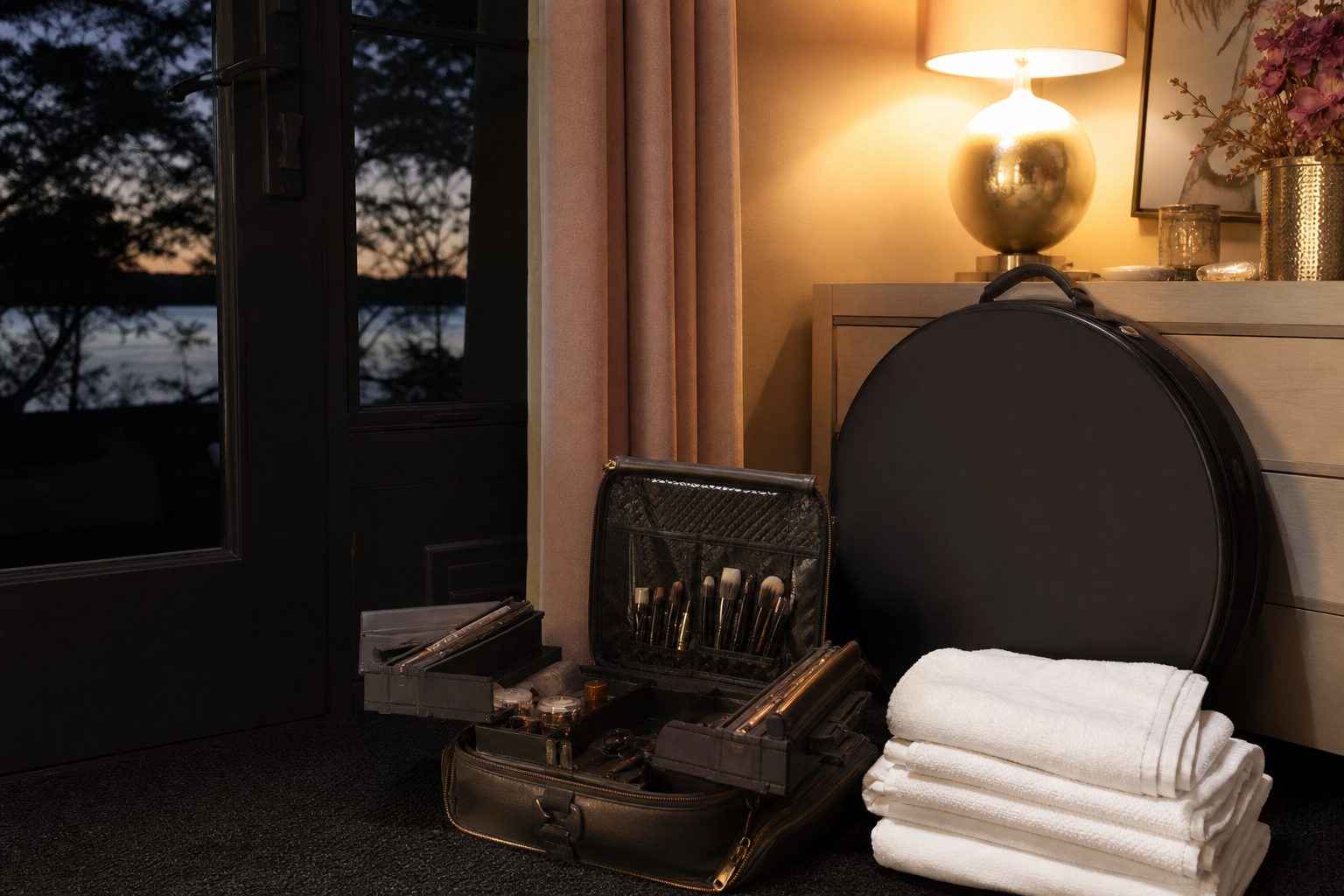
The night before a wedding is not the time to think. It is the time to execute a list you built months ago and have not changed since, because every decision you leave for 5:40 in the morning is a decision you will make badly with a travel mug in one hand.
The short answer: your night before checklist has eight parts. Brushes washed and fully dry, disposables restocked to a fixed count, the call sheet confirmed with every artist on the job, the venue and parking details verified against the actual address, power and lighting packed and tested, the day of point person identified by name and cell number, a backup kit for the three things that fail most, and a clean split between what rides in the car and what you carry up.
Done properly it takes about ninety minutes. Done badly it takes twenty minutes and costs you forty on the wedding morning, which is the only forty minutes that has no slack in it.
Sanitation and brush turnaround the night before
Brushes are the item with the longest lead time, so they go first. A deep cleaned natural hair brush needs six to eight hours lying flat to dry to the core, and a dense buffing brush can need longer. If you start washing at ten at night for a 5:00 alarm you are packing damp brushes, and damp brushes in a closed roll for a two hour drive is how you grow something you do not want near a bride's face.
The practical fix is a two set rotation. One full set works the wedding, the other sits clean and dry in a sealed roll. You wash the used set the afternoon you get home, not the night before the next job. The night before is for spot checking, not laundry.
What actually needs sanitizing versus what needs replacing
- Metal tools, lash curlers, tweezers, palettes, spatulas: 70 percent isopropyl, wiped and air dried.
- Cream and lip products: sanitizing spray on the surface, then a scrape of the top layer with a clean spatula before the first face.
- Pencils: sharpened between every client, no exceptions, so make sure your sharpener is clean and you have a spare.
- Powders: alcohol spray, then wipe. If a pan is cracked or has a hardened film, it is done. Replace it now, not in the hotel suite.
- Mascara wands, lip wands, sponges, powder puffs used on skin: single use only. These are consumables, not tools.
Check your state board rules while you are at it, because they differ. Several states require that anything touching a client be single use or sanitizable, and a few require a covered container for clean tools and a separate marked container for used ones. If you are licensed, the covered container requirement is the one inspectors notice.
Keep reading: How much of my bridal package price is actually left after kit, travel and assistants?
Restocking disposables, lashes and pins
Set a fixed par count per head, then multiply by the party size plus two. The plus two covers the mother of the bride who was not on the contract and the bridesmaid who wants her lashes redone after she cries during the letters.
| Item | Per face | Party of 8, restock to |
|---|---|---|
| Mascara wands | 3 | 30 |
| Lip wands | 3 | 30 |
| Cotton swabs | 6 | 60 |
| Blending sponges | 1 | 10 |
| Strip lashes | 1 pair | 12 pairs |
| Bobby pins | 25 to 40 | 400 loose plus a full box |
Pins are the item people underestimate. A single updo with a fine hair bridesmaid can swallow forty pins, and half of them end up on the carpet. Carry them in matte black, brown and blonde, in a screw top jar, not the flip lid tin that opens in a bag.
Lash glue and hairspray both have a real shelf life. Glue that has thickened will string, and a nearly empty hairspray sputters and spits at exactly the wrong moment. Weigh the can in your hand. If it feels light, it is not coming.
Confirming the call sheet with every artist
Confirmation is not a group text saying "see you at 7." It is each artist acknowledging three specific things: their arrival time, the address they are arriving at, and the names in their chairs in order.
Say a party of nine with two artists. If your second artist thinks she starts at 7:30 because that was the plan two weeks ago, and you moved her to 7:00 when the photo window shifted, you have lost half an hour of a schedule that has no half hour in it. The fix is a shared call sheet that both artists are looking at, with per person times and assignments visible, so there is no version of the schedule living only in your head.
Ask for an explicit reply from each artist by 8:00 the night before. Anyone who has not replied gets a phone call, not another text. This is the single highest value fifteen minutes of your prep.
Checking the venue, parking and load in
Pull up the actual address in a maps app the night before and look at the satellite view. Hotels and estate venues frequently have a service entrance that is not where the pin drops. Note the following and write them on the call sheet, not in your memory:
- Exact street address and suite or room number.
- Where you park, whether it is valet only, and whether the venue validates.
- Whether there is a loading zone with a time limit.
- Elevator location, and whether a service elevator requires a key or a staff escort.
- Any gate code, security desk sign in, or list your name must be on.
Estate and barn venues in rural counties are the ones that catch people out, because cell service can fail at the gate and you cannot call anyone to be let in. Screenshot the directions. A screenshot works with no bars.
Keep reading: What actually happens when the bride runs forty minutes late on the wedding morning?
Power, lighting and chair setup
Assume the room has one usable outlet and it is behind the bed. Pack a heavy duty extension cord, at least fifteen feet, plus a surge protected power strip. Two hot tools on a shared strip is fine. Two hot tools plus a steamer on a hotel circuit is how you trip a breaker in a room where nobody knows where the panel is.
Bring your own light. Getting ready suites are lit warm and dim, and shooting a bride under a 2700K hotel lamp gives you skin you cannot judge. A daylight balanced light on a stand, at eye level, angled slightly down, is the difference between makeup that works in the ceremony and makeup that looks gray in photos.
Charge everything the night before and put it by the door: light batteries, phone bank, cordless tool, and your own phone. Chairs matter too. Ask whether the venue has a counter height stool. If not, your director's chair goes in the car, because doing nine faces bent over a low armchair will end your back by noon.
Client contact and the day of point person
Text the bride the night before with something short and warm that also does a job. Confirm the start time, confirm the address, and ask one question: who is the person you should call in the morning if she is not answering.
Brides are not reachable on a wedding morning. That is not a failure on their part, it is the nature of the day. You need a maid of honor, a planner, or a mother with her phone on and the willingness to knock on a bathroom door. Get that name and number, and put it on the call sheet where every artist on your team can see it.
Also confirm one logistical detail that people forget: hair washed and fully dry before you arrive, and clothing that comes off over the shoulders, not over the head. Say it plainly and say it once.
See how BrushCallSheet handles this for bridal hair and makeup artistry
Backup products and the emergency kit
The failure list is short and predictable. Build a small sealed pouch that lives in the kit permanently and gets checked, not repacked, each night.
- Second lash glue and second hairspray, both unopened.
- Setting spray backup, because the pump is what fails.
- A spare hot tool or at minimum a spare cord if your tool has a detachable one.
- Blotting papers, deodorant wipes, safety pins, clear elastics, double sided fashion tape.
- Stain remover pen, a lint roller, and a Tide type wipe for the inevitable foundation on white.
- Basic first aid: bandages, antihistamine, ibuprofen, and something for a client's small cut.
Then the redundancy pack: your two most used foundation shades, a neutral lipstick, and a mascara. If a bag walks off or spills, those three items get you through a face.
What to leave in the car versus carry up
Decide this the night before and pack in that order, so the trunk opens with the carry up items on top. The rule is simple: anything you need in the first thirty minutes goes up on the first trip. Everything else waits until you know the room.
| First trip up | Stays in car until needed |
|---|---|
| Main kit, brush roll, light and stand | Second full kit or restock case |
| Extension cord and power strip | Chair, if the venue has seating |
| Hot tools and pins | Backup hot tools |
| Printed call sheet and towels | Steamer, extra mirrors, spare stand |
| Water and something to eat standing up | Cooler, personal bag, change of clothes |
One more thing goes on the front seat: the printed call sheet. Paper does not die at 40 percent battery in a suite with no charger free.
Turning the checklist into a habit
Every item above exists because a wedding morning went sideways once and someone wrote down why. The checklist is not the work. The work is having the timeline settled early enough that the night before is genuinely just packing.
That is the part worth systematizing. When per person timing, artist assignment and the venue details all live in one shared call sheet that your team confirmed days ago, the night before becomes a physical task instead of a planning session. BrushCallSheet is built for exactly that handoff, trial through wedding day, so the schedule everyone is working from is the same schedule. Build it once, confirm it, then go to sleep.
Read also

How much of my bridal package price is actually left after kit, travel and assistants?
A cost structure breakdown for a wedding day booking, from product cost per face and mileage to second artist pay, so you can see what your effective hourly rate really is.
What actually happens when the bride runs forty minutes late on the wedding morning?
An account from inside a delayed getting ready room, tracking how the timeline absorbed the loss, which services were compressed, and what the artist would rebuild differently.
How long should I actually budget per person for bridal hair and makeup on a wedding morning?
A working method for building per person timing from your own trial data, with buffer placement, the bride's slot, and the two points where a wedding morning timeline usually breaks.