How much of my bridal package price is actually left after kit, travel and assistants?
A cost structure breakdown for a wedding day booking, from product cost per face and mileage to second artist pay, so you can see what your effective hourly rate really is.

Less than you think, and the gap is almost always in hours rather than product. A $1,800 bridal package with a second artist, an hour of driving each way and a full trial can easily land at an effective rate under $45 an hour before you set aside a dollar for tax. That is not a disaster. It is just a different number than the one on the invoice.
The honest way to find your real margin is to stop looking at the package price and start with two questions. How many hours does this booking actually consume, including the ones nobody bills for, and what leaves your bank account because you took it? Everything else is arithmetic.
Below is a full worked example using one set of assumptions. They are assumptions, not benchmarks, and yours will differ. Swap in your own numbers as you read.
Counting the full hours a wedding day consumes
Most artists price against chair time. Chair time is maybe half of what the booking costs you. Here is the full accounting for a single Saturday wedding, party of six, two artists, ninety minutes of driving round trip.
| Activity | Hours |
|---|---|
| Inquiry, quoting, contract, deposit follow up | 1.5 |
| Trial: prep, session, notes, travel | 4.0 |
| Timeline build and call sheet coordination | 1.5 |
| Night before kit prep and sanitation | 1.5 |
| Travel to and from venue | 1.5 |
| Load in, setup, chair time, breakdown | 6.0 |
| Post job cleanup, restock, invoicing | 1.5 |
| Total your hours | 17.5 |
Seventeen and a half hours for a job most people describe as "a five hour wedding morning." The coordination hours are the ones that quietly expand, especially when the timeline gets rebuilt three times because the photographer moved first look.
Keep reading: What actually happens when the bride runs forty minutes late on the wedding morning?
Product cost per face and how to estimate it
Artists routinely guess this at either $3 or $30 and both are wrong. Estimate it properly with a use count.
Take a product, note its price, and estimate how many faces it serves before it is finished or expired. A $46 foundation that covers roughly 60 faces is about $0.77 per face. Run that across the kit:
- Foundation, concealer, powder: roughly $2.00 per face
- Blush, bronzer, eyeshadow, brow, liner, mascara: roughly $1.75 per face
- Lip and setting spray: roughly $1.25 per face
- Strip lashes and glue: roughly $4.00 per face
- Disposables, wipes, cotton, sponges: roughly $2.50 per face
- Hair: spray, pins, product, elastics: roughly $3.50 per head
That is about $15 per person for hair and makeup combined. For a party of six plus the trial, call it seven faces, so roughly $105 of product on this booking.
Then add replacement. Brushes, hot tools, a light, a chair, cases and a steamer are a capital pool. If you carry $3,000 of durable equipment on a three year replacement cycle and work 30 weddings a year, that is about $33 per wedding. Small, but real.
Mileage, parking and travel fee math
The IRS standard mileage rate is published each year and is the cleanest way to value driving, because it bundles fuel, maintenance, tires and depreciation into one number. Look up the current year's rate rather than using one you remember, since it changes annually.
Using a rate of $0.70 per mile as an illustration, a 90 mile round trip is $63 of real vehicle cost. Add $25 valet at a downtown hotel and you are at $88 before you have opened a case. If your travel fee is a flat $75, you lost money on the drive and the flat fee is doing nothing except making you feel like you charged for it.
The fix is a two part travel fee: a base that covers the first 20 miles, then a per mile add on above that, plus parking billed at cost. Write it into the contract so it is a line item, not a negotiation.
Paying a second artist as contractor versus employee
This is the largest cost on the job and the one with the most legal exposure. On our example wedding, the second artist covers three faces at $175 each, or $525.
The classification question is real. The IRS looks at behavioral control, financial control and the relationship between the parties. If you set her hours, tell her which products to use, require her to wear your branding, and she works only for you, that pattern looks like employment regardless of what your agreement says. Several states apply stricter tests than the federal one, and California's ABC test in particular is difficult for a lead artist to satisfy for someone doing the same work as the business.
Practical difference in cost:
- Contractor: $525 out, a 1099 at year end if you paid her over the annual threshold, no payroll tax on your side.
- Employee: $525 in wages plus your share of Social Security and Medicare at 7.65 percent, plus federal and state unemployment, plus workers comp. Budget roughly 12 to 18 percent on top, so $590 to $620, plus payroll processing.
Talk to a CPA in your state before you decide. Misclassification is assessed against you, not the artist.
Keep reading: How long should I actually budget per person for bridal hair and makeup on a wedding morning?
Insurance, licensing and card processing fees
General and professional liability for a solo artist commonly runs a few hundred dollars a year, and many venues will not let you set up without a certificate naming them as additional insured. If you pay $400 a year and work 30 weddings, that is about $13 per booking.
Licensing depends entirely on your state. Some require a cosmetology or esthetics license to do makeup for pay, some do not regulate makeup at all, and several require a separate booth or mobile permit for working outside a licensed establishment. Check your own state board, because the rules for a hotel suite and for a private residence can differ within the same state.
Card fees are easy to forget. At roughly 2.9 percent plus $0.30 per transaction, a $1,800 package charged across a deposit and a balance costs about $53. If you charge sales tax on product or services in your state, it flows through your account too, but it was never yours.
Self employment tax and quarterly set aside
Self employment tax is 15.3 percent on net earnings, covering both halves of Social Security and Medicare, and it applies before any income tax. On top of that sits your federal bracket and, in most states, state income tax.
A workable rule for a sole proprietor in a moderate bracket is to set aside 25 to 30 percent of net profit, transferred to a separate account the day money lands. Not at quarter end. The day it lands. Then pay estimated taxes on the four federal due dates, roughly mid April, mid June, mid September and mid January, so you avoid an underpayment penalty.
See how BrushCallSheet handles this for bridal hair and makeup artistry
Calculating your effective hourly rate
Now assemble the example. Package $1,800, which includes the trial, the bride, five party members and a second artist.
| Line | Amount |
|---|---|
| Package revenue | $1,800 |
| Second artist, contractor | ($525) |
| Product, 7 faces at $15 | ($105) |
| Equipment replacement allocation | ($33) |
| Mileage, wedding day and trial | ($126) |
| Parking | ($25) |
| Insurance allocation | ($13) |
| Card processing | ($53) |
| Net profit before tax | $920 |
| Tax set aside at 28 percent | ($258) |
| What you keep | $662 |
Divide $920 by 17.5 hours and the pre tax effective rate is $52.57. After tax set aside, $37.83 an hour. That is your real number, and it does not yet include marketing, website, software, or the unbilled hours you spend answering inquiries that never book.
What to change when the number is too low
Four levers move it, in order of how much they move it.
- Cut coordination hours. This is the biggest quiet cost. Three hours of building and rebuilding a timeline by text is three hours nobody paid for. Getting that to one hour adds roughly $8 an hour to your effective rate on this job without changing a single price.
- Fix the travel fee. Base plus per mile plus parking at cost. On the example above, correcting a flat fee to actual cost recovers $151.
- Reprice the party, not the bride. Party members are where volume and margin live. Moving five party members from $150 to $175 adds $125 with no added time.
- Set a minimum. A Saturday in peak season has one slot. A booking below your minimum does not just earn less, it blocks the one that would have earned more.
Raising your package price is the fifth lever, and it works, but do the other four first because they cost the client nothing.
Where the hours actually go back
If you run this math on your last three weddings you will likely find the same thing most team leads find: product is not your problem, and the second artist is priced about right. The leak is the coordination, the version control on the timeline, and the twenty text messages it takes to confirm who is in the chair at 7:40.
That is a fixable cost. BrushCallSheet takes the trial notes through to a per person wedding morning timeline with artist assignments and a shared call sheet the whole party can see, so the schedule is built once and confirmed once. Run the numbers above on your own bookings first, then look hard at the coordination line. It is usually the cheapest hour you will ever buy back.
Read also
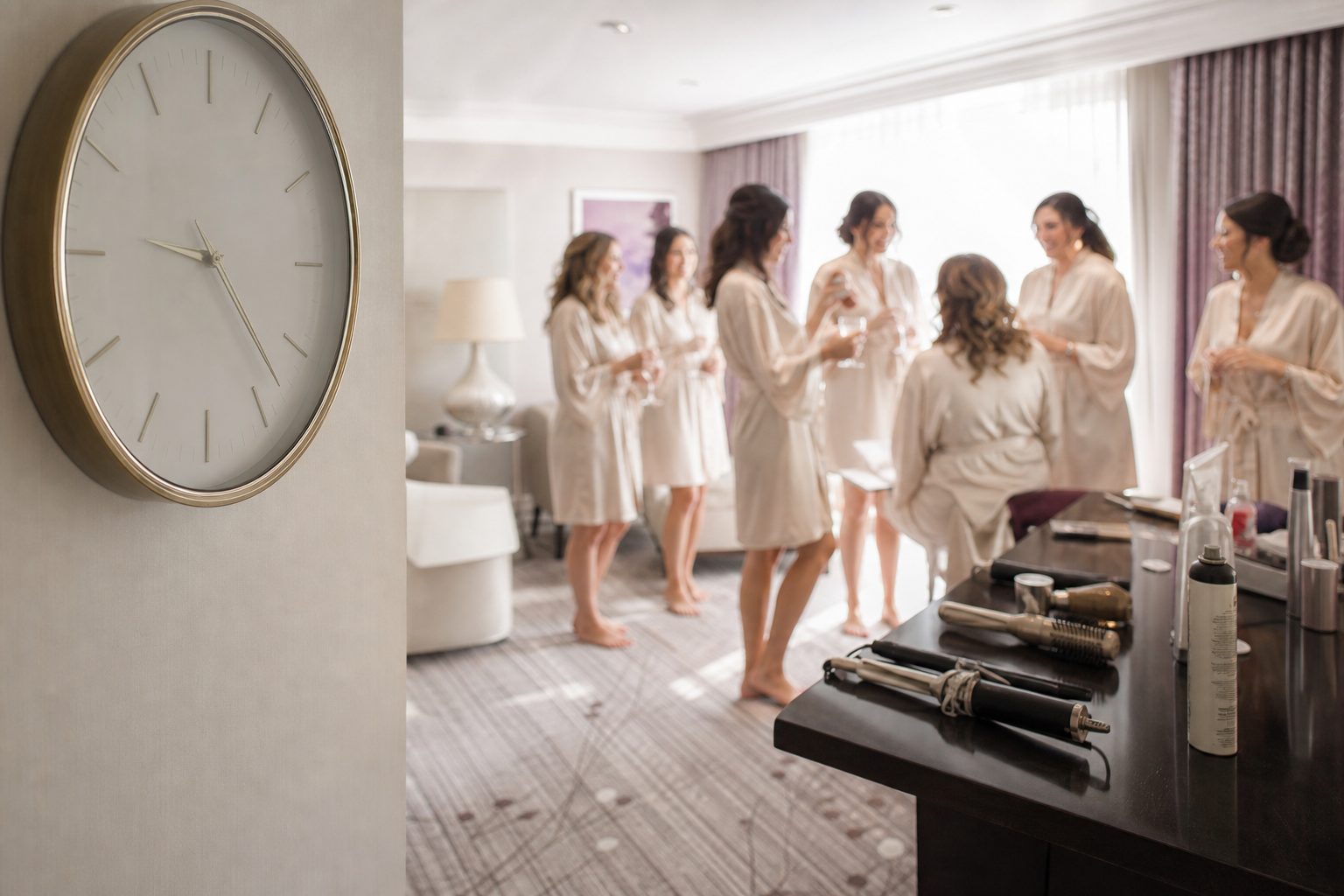
What actually happens when the bride runs forty minutes late on the wedding morning?
An account from inside a delayed getting ready room, tracking how the timeline absorbed the loss, which services were compressed, and what the artist would rebuild differently.
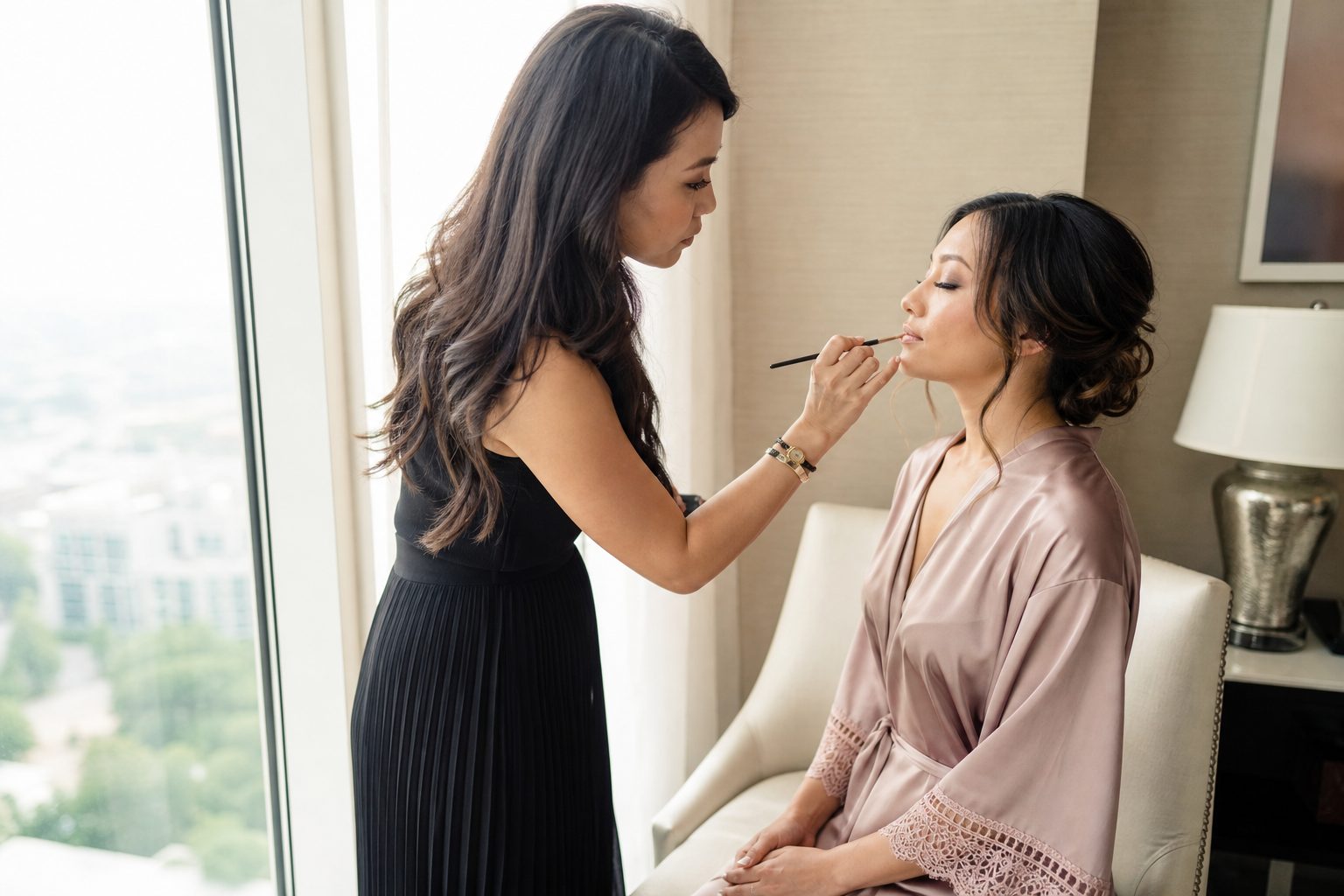
How long should I actually budget per person for bridal hair and makeup on a wedding morning?
A working method for building per person timing from your own trial data, with buffer placement, the bride's slot, and the two points where a wedding morning timeline usually breaks.

Should I charge a flat bridal party rate or price every service individually this season?
Flat party packages and per service menus behave very differently when the count changes, the timeline stretches, or a mother of the bride adds on. Here is how each structure holds up.