Should I charge a flat bridal party rate or price every service individually this season?
Flat party packages and per service menus behave very differently when the count changes, the timeline stretches, or a mother of the bride adds on. Here is how each structure holds up.
If you work alone and your bookings are mostly small parties, per service pricing will almost always serve you better. If you send teams, and your inquiries arrive as "eight of us, hair and makeup, at the hotel," a flat party rate protects your margin and your sanity. Most artists running a season of both end up with a hybrid: a per service menu with a party minimum attached to it.
The reason the two structures behave so differently is not the headline number. It is what happens after the contract is signed. Bridal parties change. A sister in law flies in. The mother of the groom decides she wants hair only. One bridesmaid cancels three weeks out. Each of those events lands on your revenue in a completely different way depending on which structure you chose.
Here is how each one actually holds up across a full season, and how to decide which one you are running.
What each pricing structure is really selling
A per service menu sells units of work. Bridal makeup, 250. Bridal hair, 250. Bridesmaid makeup, 135. Bridesmaid hair, 145. The client assembles her own total. Your revenue tracks headcount linearly.
A flat party rate sells a block of your morning. Six services, four hours on site, two artists, one number. The client is not buying applications, she is buying the guarantee that everyone is finished and camera ready by the time the photographer wants the dress shot.
That distinction matters because it changes what you are accountable for. Under a menu, you are accountable for each face. Under a flat rate, you are accountable for the morning. A bride who asks "can you also do a quick touch up on my aunt" is asking for something free under a flat rate and something billable under a menu, and neither of you will have thought about that in advance unless the contract says so.
Where each one prices badly
A menu underprices complexity. Two bridesmaids at 145 for hair are not the same job when one has a bob and one has thirty inches of extensions, but the menu charges the same.
A flat rate underprices the small booking. A three person party at your six person flat rate reads as expensive and you lose the inquiry to someone quoting a la carte.
Keep reading: What goes wrong when I book a bridal trial three months before the wedding day?
How add ons and drop offs hit each model
This is where the structures separate hardest. Take a booking of bride plus five, both services, and run two changes through it.
| Event | Per service menu | Flat party rate |
|---|---|---|
| One bridesmaid added, both services | Revenue rises by 280. Time rises by about 80 minutes. | Revenue rises only if your contract has a per head add on clause. Time rises the same 80 minutes. |
| One bridesmaid cancels | Revenue falls by 280 unless a minimum catches it. | Revenue is unchanged. The block was sold. |
| Mother switches from both to hair only | Revenue falls by her makeup price. | Revenue unchanged. |
That table explains a pattern most artists notice before they can name it. Menus are exposed on the downside. Flat rates are exposed on the upside.
Under a menu, every cancellation is a direct revenue cut on a date you can no longer resell. Under a flat rate, cancellations cost you nothing and additions cost you real labor for zero extra money, unless you wrote an add on rate into the agreement. That clause is the single most important line in a flat rate contract.
The fix in both directions is the same idea: lock the count at a date. Take the headcount at contract signing, then re confirm at 30 days out. After the 30 day confirmation, the count is the count. Additions are billed at your published add on rate and require you to confirm capacity. Removals do not reduce the balance.
Minimums, and why they are separate from the rate
A minimum is not a price. It is a floor on the value of a Saturday in September, and it exists whether or not you use a flat rate.
Build it from what a date is worth to you, not from what the services add up to. Assume a peak season Saturday where you would realistically book a six person party. Six people, both services, averages out to roughly 1,600 in service revenue on a menu. If you accept a two person booking for 750 on that same date, you have not made 750, you have lost the difference between the two, minus whatever you would have spent working the larger job. Those figures are illustrative, not a market rate. Put your own average party value in.
Practical structure that works for a lot of artists:
- A weekday or off season minimum, low, because the alternative is an empty date.
- A peak Saturday minimum, meaningfully higher, applied from May through October.
- A holiday weekend minimum above that.
- The minimum stated as a total the booking must reach, with services billed from the menu against it. If the menu total falls short, the client pays the minimum.
Stating it that way is important. "Our Saturday minimum is 1,200" reads as a threshold. "Our Saturday package is 1,200" reads as a price, and then a bride with four people feels she is being charged for two who do not exist.
Keep reading: Do I need a cosmetology license to do bridal makeup on location in my state?
Paying a second artist under each structure
Your assistant artist has to be paid consistently, whichever way you charge the client. Pick one of these and keep it the same across the season.
- Per service split. The artist receives a fixed percentage of the menu price of each service she performs, commonly somewhere between 50 and 70 percent depending on whether you supply the kit and the leads. Clean under a menu. Awkward under a flat rate, because there is no menu price to split.
- Day rate. A flat fee for the morning, plus a per service overage above an agreed number of faces. Clean under a flat rate. Under a menu it can leave you paying a day rate on a booking that only generated three services.
- Hourly with a minimum call. An hourly rate with a four or five hour minimum, plus travel time. Fair to the artist, but it rewards a slow morning, which is the wrong incentive on a wedding day.
Whichever you use, decide in advance who absorbs parking, tolls and the early call. If the venue charges 45 for valet and your artist is arriving at five thirty, that is a real cost and it belongs in the client's travel fee, not in your artist's pocket.
One more thing that catches people: classification. Whether your second artist is an employee or an independent contractor is determined by federal and state tests, not by what you both agree to call it, and several states apply stricter tests than the federal one. If you are directing her schedule, her products and her methods, get advice on it rather than assuming a signed 1099 agreement settles the question.
What the contract has to say for each model
Both models need the same skeleton. The differences are in three clauses.
Common to both:
- Date, venue address, arrival time and the time the last service must be complete.
- Exact headcount and the services each person is receiving.
- Travel fee, parking, and any early start fee with the time it triggers at.
- Deposit amount, whether it is refundable, and the balance due date.
- Cancellation terms by distance from the date.
- Whether touch ups or an on site stay through are included, and until what hour.
Menu specific: the price list attached as a schedule, so a change in headcount recalculates against a fixed set of rates rather than a new negotiation. Also the minimum, stated as a floor.
Flat rate specific: what the block includes, stated as a count and a duration. "Up to six services across four hours on site." Then the add on rate per additional service, and an overtime rate per half hour beyond the block. Without those two numbers a flat rate has no defense against scope creep.
See how BrushCallSheet handles this for bridal hair and makeup artistry
Deposits, retainers and the balance schedule
The deposit does two jobs: it holds the date and it makes the booking real. Common practice is 25 to 50 percent of the anticipated total, non refundable, due at signing. Many artists label it a retainer rather than a deposit precisely because "deposit" implies something returnable.
The balance schedule is where the two models diverge again. Under a flat rate, you can invoice the full balance at the 30 day confirmation, because the number cannot move. Under a menu you cannot finalize until the count is locked, so run it in two steps: confirm the roster at 30 days, issue the final invoice, and require payment before the wedding date rather than on the morning.
Which structure fits a solo artist versus a team
A decision rule you can apply to your own inquiry list:
- Look at your last twenty bookings. Count how many were four people or fewer.
- If more than half were small, stay on a per service menu with a seasonal minimum. Flat rates will cost you those inquiries.
- If most were six or more and you brought a second artist, move to a flat rate for those, with a per head add on and an overtime rate.
- If you are split, run the menu as your public pricing and quote a flat block only when the party exceeds your minimum anyway. The client sees consistency, you get predictability on the big jobs.
Whichever you land on, the structure only works if the same numbers appear in the inquiry reply, the contract, the invoice and the schedule you hand your team. That is where most pricing systems quietly fail: not in the decision, but in the four places the decision has to stay consistent.
Making it hold together
Pricing structure and morning logistics are the same problem viewed from two ends. The headcount you locked at 30 days is the headcount your timeline is built from, and the artist you are paying is the artist assigned to a specific chair at a specific minute.
BrushCallSheet keeps those tied together, from the trial through to a shared call sheet the whole party and every artist on the team works from. When the count changes, the schedule and the assignments change with it, in one place.
Read also
What goes wrong when I book a bridal trial three months before the wedding day?
The trial is where wedding morning timing, product decisions and expectations get set. These are the errors that quietly cost you time and revisions later in the season.
Do I need a cosmetology license to do bridal makeup on location in my state?
Licensing for makeup artistry, hair services and mobile work is set state by state. Here is how to read your board's rules, and which parts of the job are almost never exempt.
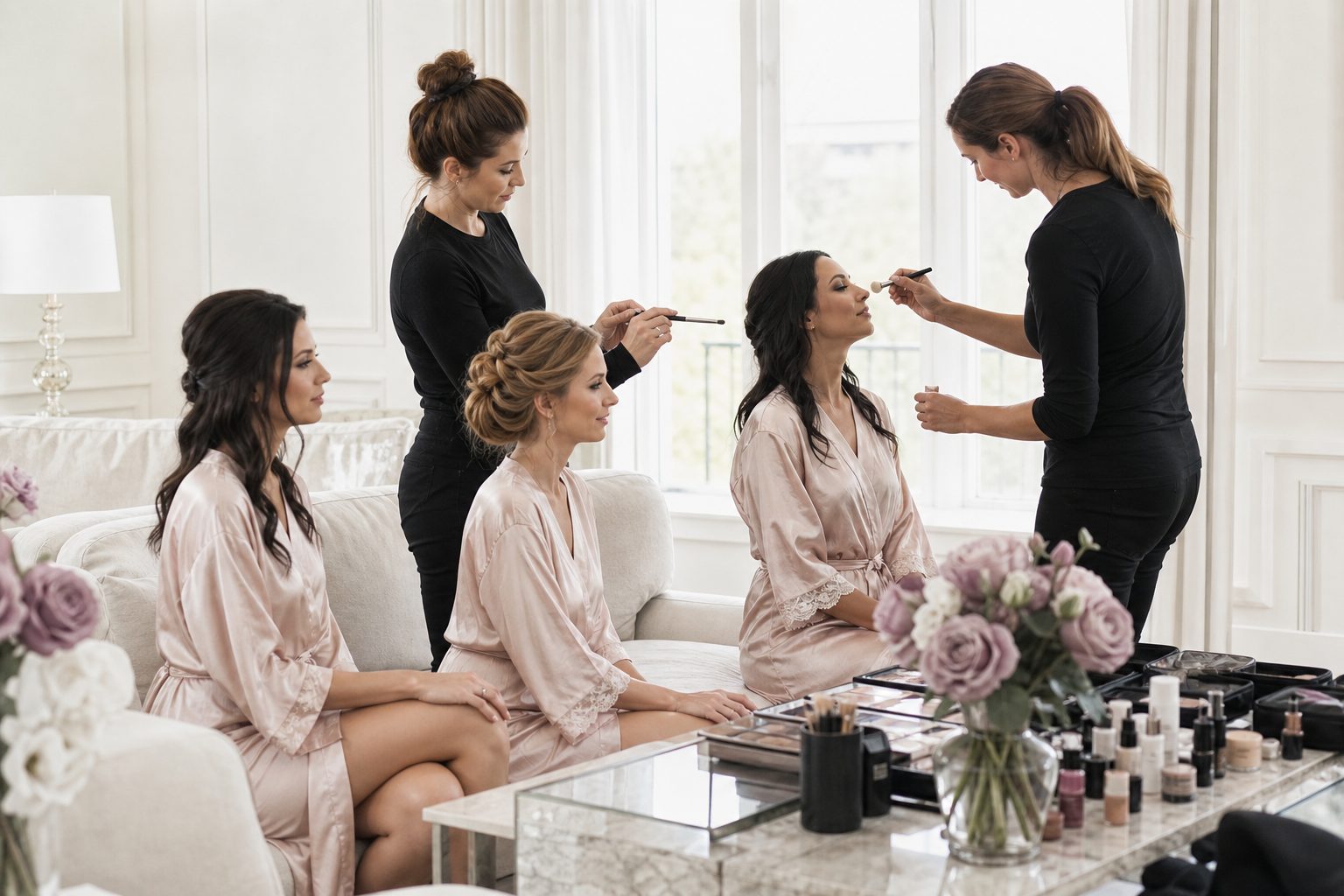
How do other artists staff a fourteen person bridal party across two getting ready rooms?
A detailed walkthrough of how a large split location wedding morning gets staffed, sequenced and run, including the handoffs that keep two rooms on the same clock.