What actually happens when the bride runs forty minutes late on the wedding morning?
An account from inside a delayed getting ready room, tracking how the timeline absorbed the loss, which services were compressed, and what the artist would rebuild differently.
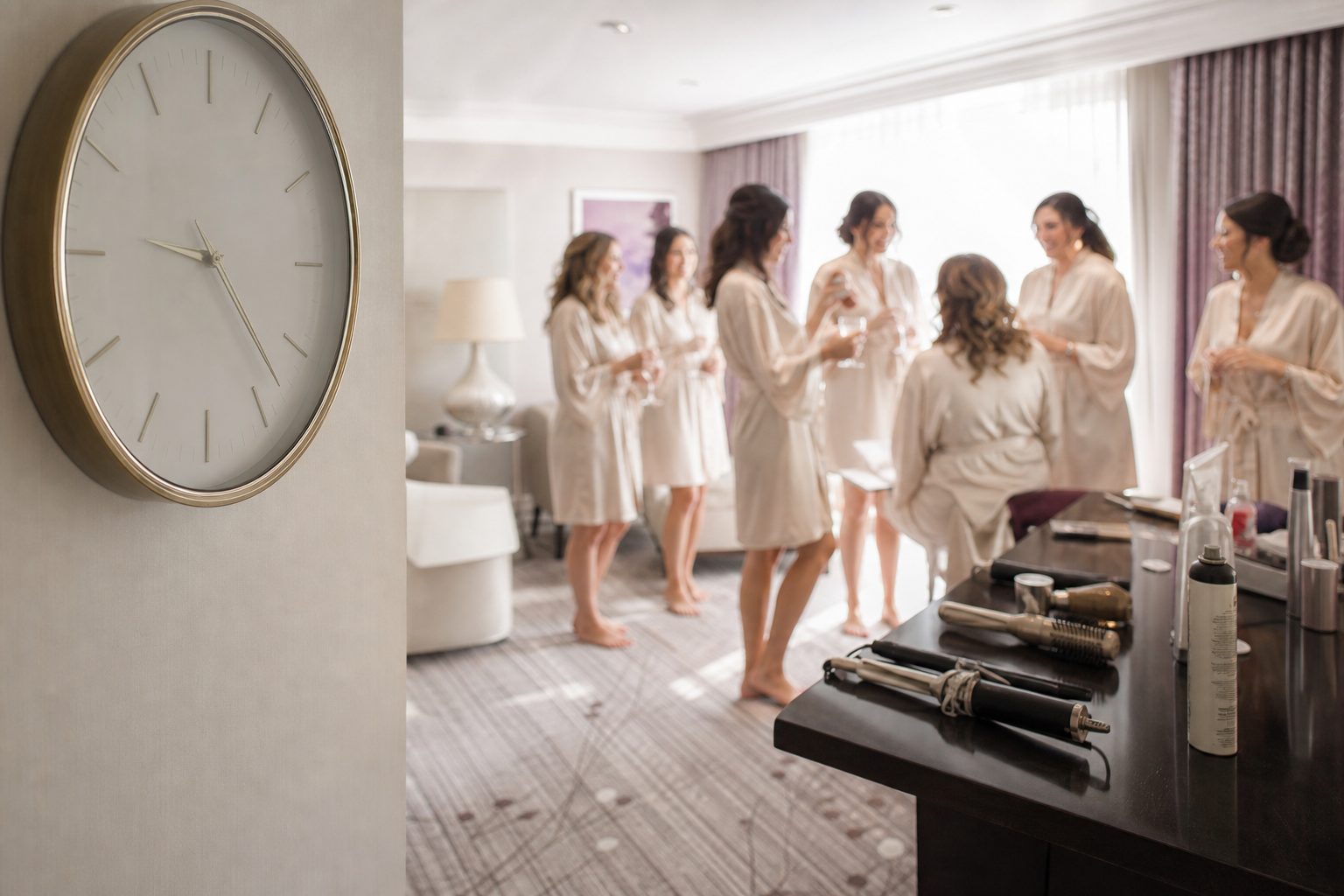
Nothing dramatic happens. That is the first thing to understand. Forty minutes does not arrive as a crisis, it arrives as a bride who went downstairs to greet her aunt at 8:15 and is not back at 8:55, and a room that has quietly stopped moving.
What happens next is entirely determined by whether you have a per person timeline or a vague sense of the morning. With a timeline you know within two minutes which chairs still have slack, which service you can shorten by ten and which you cannot touch, and who needs to be told. Without one you compress everything a little, finish on time, and hand the photographer six faces that all look slightly rushed.
This is an account of one morning where the loss was absorbed, assembled from how these mornings actually run, and what the timeline looked like the next time it was built.
The first sign the schedule had slipped
The tell was not the bride. It was the third bridesmaid.
The call sheet had Rachel in the hair chair at 8:10. At 8:22 she was still in the corridor on the phone with the florist, because the mother of the bride had handed her that problem at 8:00. Twelve minutes on a single chair is survivable. What made it worse was that the bride had gone downstairs at 8:15 with damp hair pinned up, which meant the 8:40 blow dry start was not going to happen either.
Two small slips, in different directions, on two different artists. Neither person thought they had done anything wrong. That is what a slipped schedule looks like from inside the room: no single event, just a set of small overruns that nobody adds up because nobody is holding the whole picture.
The moment to act is when the sum crosses fifteen minutes, not forty. Fifteen is recoverable with sequencing alone. Forty requires cutting something.
Keep reading: How long should I actually budget per person for bridal hair and makeup on a wedding morning?
Who to tell first, and what the planner needs
The planner. Immediately, and with a number.
Not "we're running a bit behind." The planner cannot do anything with that. She needs: "We are forty minutes down. Bride's makeup now starts at 10:20 instead of 9:40. She will be ready for her dress at 11:10. Do you want me to protect the first look, or should I compress the last two bridesmaids?"
That framing does three things. It gives a specific new time, it names the downstream event that is at risk, and it offers a decision that belongs to the planner and not to you. Planners will rearrange an entire morning cheerfully if you give them forty minutes of notice and a clear choice. What they cannot forgive is finding out at 11:05.
Second call is the photographer, if there is no planner. She has the getting ready detail shots and the first look built into her own schedule, and she is the person who can most usefully tell you that the ceremony has real slack or none at all.
The bride is told last, briefly, calmly, and only with the resolution: "You are in my chair at 10:20 and you will be ready before the dress goes on. Nothing is at risk." She does not need the arithmetic.
Which services compress and which cannot
This is the working knowledge that makes the difference. Some services have real elasticity and some are physics.
| Service | Elasticity | Note |
|---|---|---|
| Bridesmaid makeup | Can lose 10 min of 45 | Simplify the eye, skip the cut crease |
| Bridesmaid half up | Can lose 10 min of 40 | Fewer pins, looser finish |
| Blow dry on thick hair | Almost none | Wet hair does not negotiate |
| Curl set and cool down | None | Curls dropped early will not hold to the reception |
| Bridal updo | Do not touch | This is the photographed one |
| Strip lashes | None | Glue cure time is fixed |
| Mother of the bride | Can lose 10 min | Often the most gracious about it |
The rule that comes out of this: you take small amounts from many chairs, never a large amount from one. Cutting ten minutes each from four bridesmaids gets you the forty back and nobody in the room feels shortchanged. Cutting forty from one person produces a visibly worse result and a bridesmaid who mentions it in the car.
Keep reading: Should I charge a flat bridal party rate or price every service individually this season?
Resequencing the chairs mid morning
Rebuilding a running schedule under pressure has an order to it. On this morning it went like this.
- Move anyone who is physically ready forward. Two bridesmaids were dressed and sitting on the bed at 8:30 with nothing to do. They went into the chairs immediately, out of call sheet order.
- Push the people with a dependency. The bride's hair had to dry, so she moved back and the drying happened while other people were being worked on. Dead time became parallel time.
- Rebalance across artists. The second artist was running ahead, so a face moved from the lead's list to hers. This only works if both artists can see the same list.
- Split hair and makeup for one person. The maid of honor got makeup from artist two while artist one finished a different head, then came back for hair. It costs a little in flow and buys real minutes.
- Reannounce the new times out loud. Every changed name, said clearly to the room, once. Then written on the shared sheet so the flower girl's mother can see it too.
Step five is the one people skip, and it is the one that stops the next slip. A room that knows its own schedule polices itself.
Protecting the bride's slot and the photo window
The bride's slot is not moveable in duration, only in position. Her makeup and hair were the fixed block, and everything else bent around them.
The photo window is the other fixed thing, and it is worth understanding why. Getting ready coverage, the dress, the details, the first look, the bridal portraits and the wedding party photos all sit in a chain, and the ceremony start does not move. A forty minute delay in the suite does not eat forty minutes of buffer, it eats forty minutes of portraits, which is the part of the day the couple paid the most for and will look at the most.
Practically, this means the bride finishes with a buffer of at least twenty minutes before the dress, always, and you protect that buffer over almost anything else. On this morning the last bridesmaid was finished nine minutes after the bride, which is not ideal and was entirely fine.
See how BrushCallSheet handles this for bridal hair and makeup artistry
The conversation about touch ups and overtime
At 11:00 the mother of the groom, who was not on the contract, asked whether there was time for her. There was not, and saying so plainly in a calm voice took eight seconds and cost nothing.
The overtime conversation is different, and it happens before the overtime, not after. If the delay is going to push you past your contracted departure time, the sentence is: "We are booked until noon. If you would like us to stay for touch ups through the ceremony, that is our hourly rate of $X per artist, and I need to know by 11:15." Then you write it down and text it, so there is a record.
Two things make this easy rather than awkward. One, an hourly overtime rate written into the original contract, so nobody is inventing a number in a hotel room. Two, being clear that a delay caused by the client's morning is not a delay you absorb for free. Most brides are entirely reasonable about this when it is framed early and without blame.
What the artist rebuilt into the next call sheet
Four changes came out of that morning, and all of them are structural rather than personal.
- A named 8:00 anchor. One person, usually the maid of honor, is responsible for having the first two people in the room and ready at the stated time. Named on the sheet, told the night before.
- Fifteen minutes of float in the middle, not the end. Buffer at the end of a schedule is buffer you never get to use, because by then the loss has already been compressed out of everyone. A gap after the third chair absorbs a slip while it is still small.
- The bride's hair wash confirmed as a hard requirement. Washed and fully dry before arrival, stated in the contract and repeated in the night before text. Damp hair is the single most common cause of a lost half hour.
- Per person times visible to everyone. Not a block that says "hair and makeup 8 to 11." Named rows with a start time, an end time and an artist, on a sheet the bridesmaids can pull up on their own phones.
That last one is the whole lesson. A delay is not really a scheduling failure, it is an information failure. Nobody in that room knew they were late, because nobody could see the schedule they were late against.
Building the morning so it holds
Wedding mornings will slip. Aunts arrive, florists call, someone cries during the letters. The question is only whether you find out at 8:25 or 11:05, and whether you have a structure that tells you which ten minutes to take and from where.
BrushCallSheet is built for that structure: a trial to wedding day workflow with per person timing, artist assignments and a shared call sheet the whole party can see. Build the timeline once, put a name against every start time, and the room will tell you the moment it slips, while ten minutes is still all it costs.
Read also
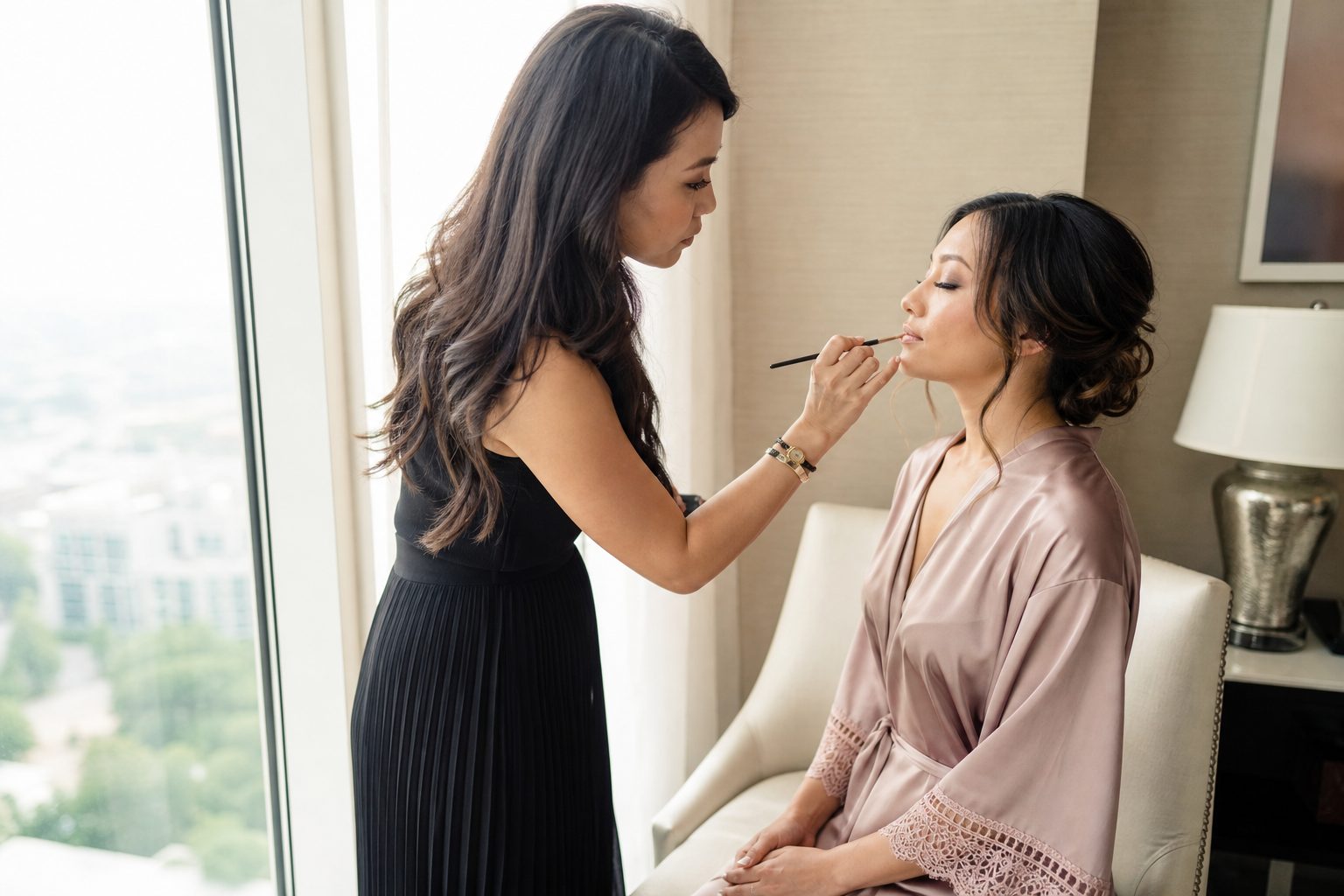
How long should I actually budget per person for bridal hair and makeup on a wedding morning?
A working method for building per person timing from your own trial data, with buffer placement, the bride's slot, and the two points where a wedding morning timeline usually breaks.

Should I charge a flat bridal party rate or price every service individually this season?
Flat party packages and per service menus behave very differently when the count changes, the timeline stretches, or a mother of the bride adds on. Here is how each structure holds up.
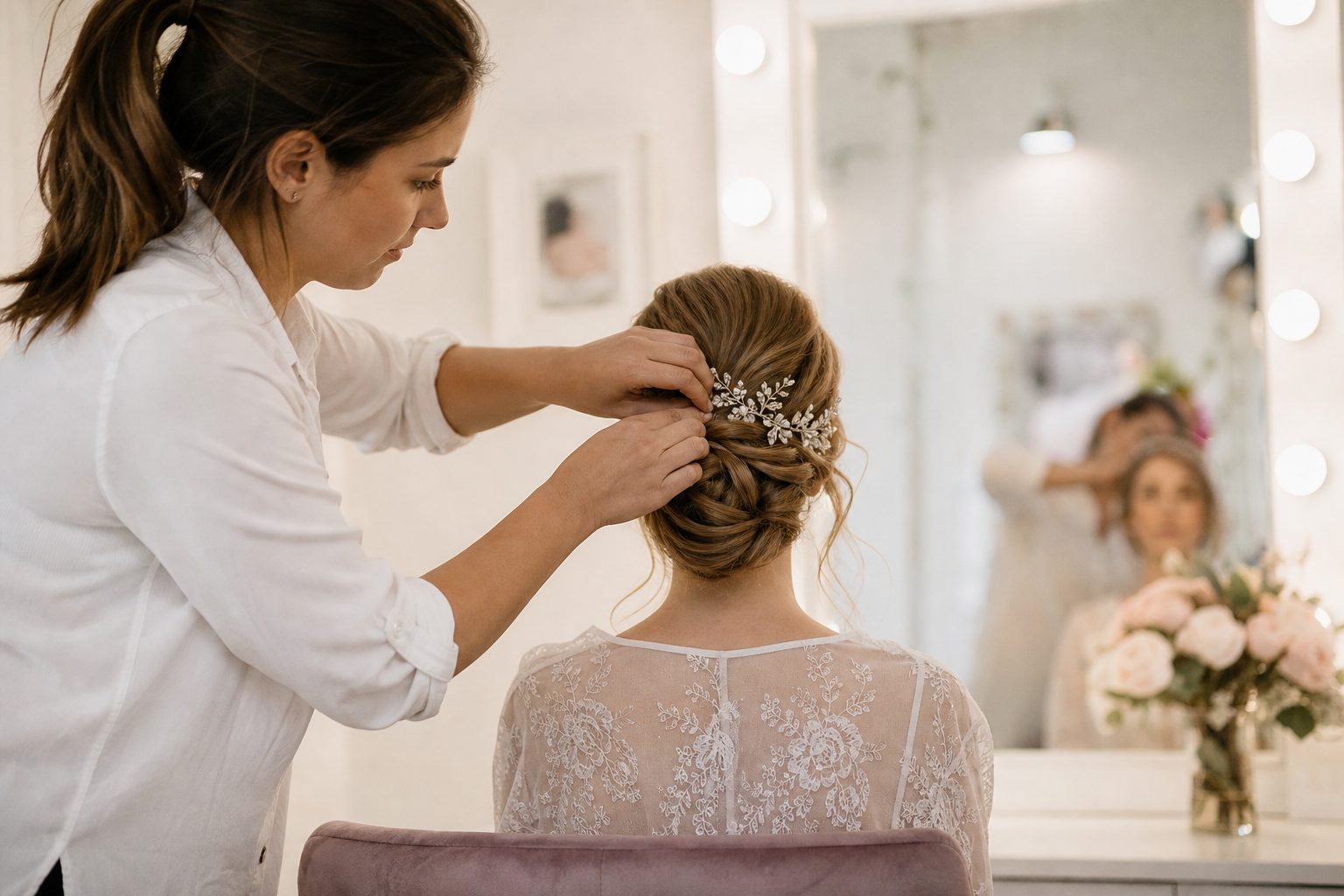
What goes wrong when I book a bridal trial three months before the wedding day?
The trial is where wedding morning timing, product decisions and expectations get set. These are the errors that quietly cost you time and revisions later in the season.