How do other artists staff a fourteen person bridal party across two getting ready rooms?
A detailed walkthrough of how a large split location wedding morning gets staffed, sequenced and run, including the handoffs that keep two rooms on the same clock.
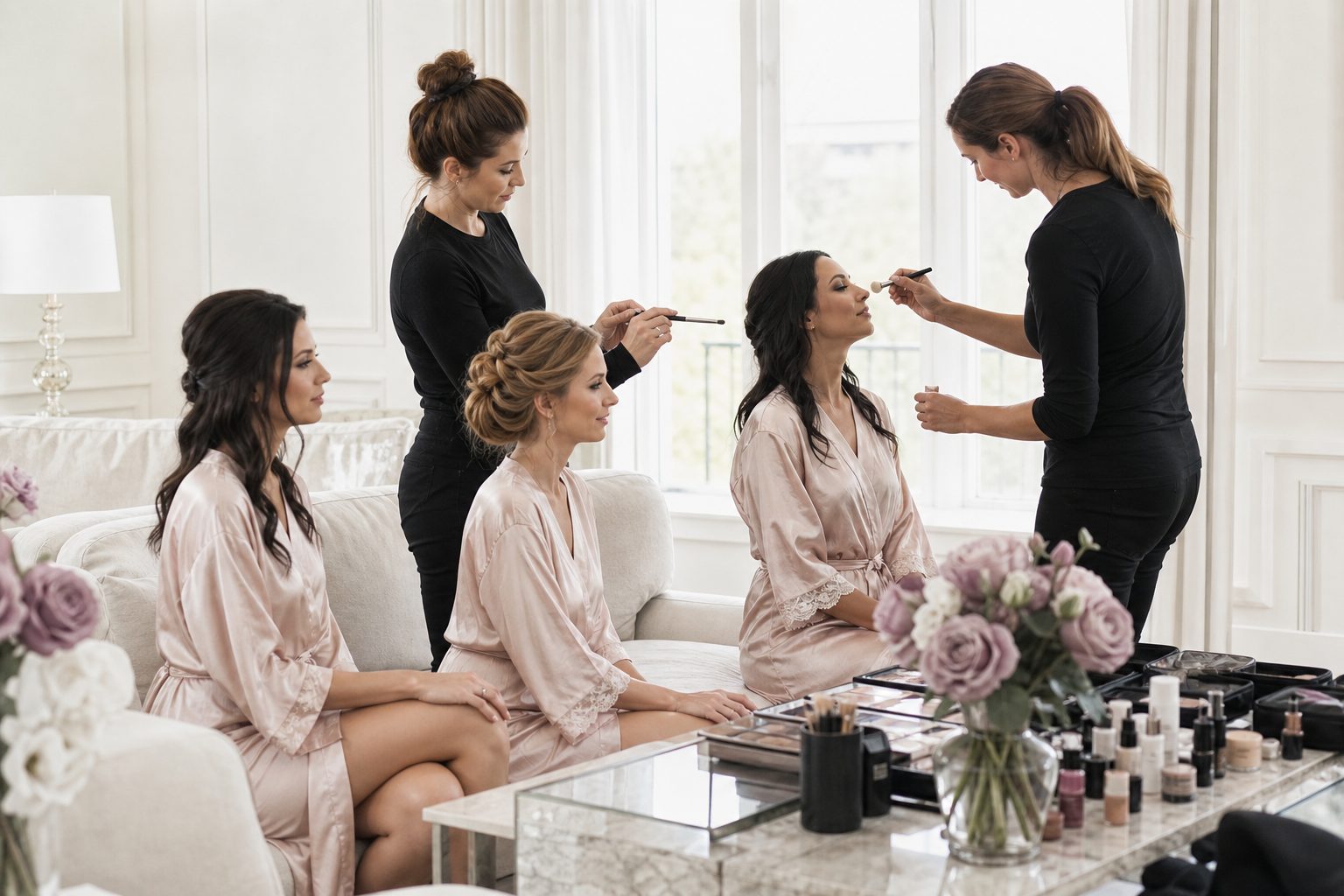
Fourteen services split across two getting ready rooms is a four-artist morning in most configurations, sometimes five, and almost never three. The math that decides it is simple: total service minutes divided by the minutes you actually have, then rounded up, then checked against the constraint that nobody can be in two rooms at once.
The walkthrough below is a composite built from the way these mornings typically run, with every number stated so you can swap in your own service times. It is an illustration, not a survey. The point is the sequence of decisions, because the staffing choice is made in the quote, weeks before anyone unzips a kit.
Assume a 2:30 pm ceremony, photographer arriving for detail shots at 11:30, and a hard "brush down" at 12:45 so the party can dress. Assume standard service times of 45 minutes for makeup and 45 for hair, with the bride at 60 and 60.
The inquiry, the count and the first timeline draft
The inquiry says "bride plus 7, maybe a few moms." That is never the final count. Ask for the names before you quote, because a list of names is harder to inflate than a number.
The list came back as: bride, six bridesmaids, mother of the bride, mother of the groom, grandmother, and two flower girls at hair only. Four of those are hair and makeup, five are makeup only, three are hair only, plus the bride. Total services on the sheet: fourteen chair sessions.
Convert to minutes before anything else.
| Service | Count | Minutes each | Total minutes |
|---|---|---|---|
| Bride hair | 1 | 60 | 60 |
| Bride makeup | 1 | 60 | 60 |
| Party hair | 6 | 45 | 270 |
| Party makeup | 4 | 45 | 180 |
| Flower girl hair | 2 | 20 | 40 |
| Total | 14 | 610 |
610 service minutes. That is the number that drives the quote.
Keep reading: Are couples still booking bridal party services, or is everyone cutting back to the bride?
Deciding how many artists each room needs
Working backward from 12:45 brush down and a realistic 7:30 start gives 315 minutes of production window. Do not use the full window. Subtract 30 minutes for setup and the inevitable late arrival, and 20 minutes at the end for bride touch ups and veil placement. Usable window: roughly 265 minutes per artist.
610 divided by 265 is 2.3. So on paper, three artists clears the work. In practice three did not, for two reasons.
First, the split location. The suite and the second room were in the same hotel but four floors apart, and an artist standing in an elevator is not producing minutes. Second, hair and makeup are not interchangeable. Two of the three would have had to be dual-skilled at full speed on both, and the sequencing constraint that nobody can have hair and makeup done simultaneously creates dead time you cannot recover.
The booking went out at four artists: two hair, two makeup. That gives roughly 153 minutes of slack across the team, which sounds generous and is not. Slack is what absorbs a bridesmaid who arrives with unwashed hair, a mother who wants her lashes redone, and the photographer who needs the bride out of the chair fifteen minutes early.
The rule of thumb worth keeping
- Add up total service minutes from the actual name list.
- Set the end time, subtract 20 minutes of bride buffer, subtract 30 minutes of front-end slippage.
- Divide total minutes by that usable window. Round up.
- Add one artist if services are split across rooms, floors or addresses.
- Add one artist if the count of hair services and makeup services differ by more than about a third, because the smaller discipline will finish early and stand around.
Splitting hair and makeup across the two spaces
The instinct is to put a hair artist and a makeup artist in each room and let each room run itself. That is the wrong shape for a split location, because it turns each room into a two-person bottleneck with no ability to rebalance.
What worked here: the bridal suite got both makeup artists and one hair stylist, because that is where the bride, both mothers, and the grandmother were. The second room got one hair stylist and the four bridesmaids who needed hair only or hair first. Bridesmaids needing makeup moved up to the suite on a schedule.
The people move, not the artists. Moving a person costs a walk. Moving an artist costs a walk plus a kit plus a station setup.
Keep reading: What should be on my kit and prep checklist the night before a wedding day?
Assigning who takes the bride and who floats
The lead artist takes the bride, always. Not because she is the best technician, though she may be, but because the bride's chair is where the timeline gets renegotiated. If the lead is buried in a bridesmaid's updo at 11:15 she cannot make the calls the morning needs.
The second decision is who floats. On this morning the second hair stylist was designated the floater from 11:00 onward, meaning her last scheduled service ended at 10:45 and everything after was touch ups, veil pins, flower girl braids, and stepping into whichever room fell behind. Building a floater into the plan looks like paying an artist to do less. It is the single cheapest insurance you can buy on a fourteen-service morning.
Everyone else got a fixed running order posted in both rooms, with names and times, not just a list of who is coming.
Travel time between rooms, and what it costs
Four floors, one elevator, a hotel at Saturday checkout. Timed at eight minutes each way including waiting, which is generous until it is not. The plan called for six planned person-moves between rooms.
Six moves at eight minutes is 48 minutes of transit, but that transit belongs to the bridesmaids, not the artists, so it does not consume service minutes as long as the next person is already in the chair. The cost only lands on the team when a room runs dry waiting for someone in an elevator.
The fix was a two-deep queue: the person after next is always already in the room. Text goes out to the person after next, not the next person. That one habit removed almost all of the transit exposure.
The rate side is worth stating plainly. Assume a four-artist team, a 6:45 call for a 7:30 start, and a 1:00 pm release. That is roughly six and a quarter hours on site per artist plus travel. If your assistant rate is 65 dollars an hour with a four-hour minimum, three assistants at 6.25 hours is 1,219 dollars in labor before the lead's own take, before parking, before the early call premium. Price the morning from that floor upward, not from a per-face number you picked in 2019.
See how BrushCallSheet handles this for bridal hair and makeup artistry
The morning as it actually ran, hour by hour
| Time | Suite | Second room |
|---|---|---|
| 6:45 | Both makeup artists and hair lead set up | Hair two sets up |
| 7:30 | Grandmother makeup, mother of groom hair | Bridesmaid one hair |
| 8:15 | Mother of groom makeup, mother of bride hair | Bridesmaid two hair |
| 9:00 | Mother of bride makeup, bridesmaid three hair | Bridesmaid four hair |
| 9:45 | Bridesmaid one makeup, bridesmaid five hair | Bridesmaid six hair |
| 10:30 | Bridesmaid two makeup, bride hair begins | Flower girls, then room closes |
| 11:15 | Bride makeup, remaining party makeup | Hair two moves up as floater |
| 12:00 | Bride finishing, touch up line forms | |
| 12:45 | Brush down, dressing begins |
Two things went wrong, both survivable. A bridesmaid arrived at 9:20 for a 9:00 hair slot, and the second room absorbed it by pulling the flower girls forward. And the mother of the bride wanted a lash strip added, unbooked, which the floater handled at 11:40. Neither moved the brush-down time.
What the artist changed for the next large party
- Names in the contract, not counts. Every service billed against a named person, with a written cutoff two weeks out for additions.
- A stated per-room minimum. Splitting the party across two spaces now carries its own line item, because it costs an artist.
- Earlier flower girls. Children finish faster and melt down later. They now go first, not in the gap.
- The floater is written on the sheet. Naming the role stops it from becoming everyone's job and therefore nobody's.
- One shared timeline, not four printouts. Paper copies in two rooms went stale the first time a slot moved.
Running the same morning without the whiteboard
Every decision above lives in one document: who is in which chair, at what minute, with which artist, in which room. Kept on paper it goes out of date the first time someone runs late. Kept in four heads it goes out of date faster.
BrushCallSheet builds that timeline once, from the trial through the wedding morning, with per person timing and artist assignment, and shares one call sheet with the whole party and team. When the 9:00 slot moves to 9:20, it moves for everyone at the same time, in both rooms.
Read also
Are couples still booking bridal party services, or is everyone cutting back to the bride?
Party sizes, add on services and booking lead times have shifted since the post pandemic surge. Here is what the change means for how you build packages and minimums.
What should be on my kit and prep checklist the night before a wedding day?
A run through of the sanitation, restock, timeline confirmation and travel prep that has to be finished before you sleep, so the morning starts with nothing left to decide.

How much of my bridal package price is actually left after kit, travel and assistants?
A cost structure breakdown for a wedding day booking, from product cost per face and mileage to second artist pay, so you can see what your effective hourly rate really is.